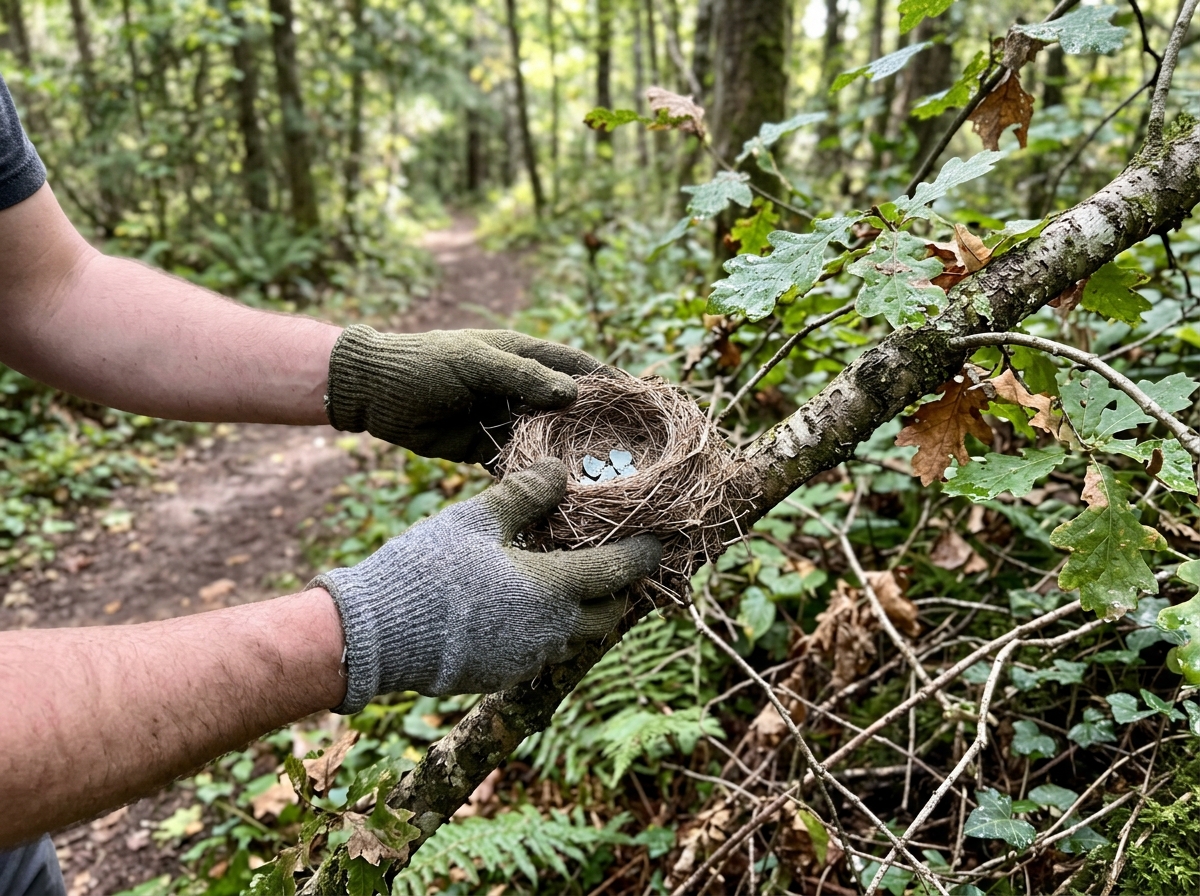
The short answer: in most cases in the U.S., Canada, and Mexico, you cannot legally move a bird nest with eggs. If the nest belongs to a native or migratory bird species (which covers the vast majority of songbirds, raptors, waterfowl, and shorebirds), it is protected under the Migratory Bird Treaty Act (MBTA). Moving the nest, handling the eggs, or even significantly disturbing the area around an active nest without a federal permit is a federal offense. That said, the situation is genuinely different depending on whether eggs are actually present, what species built the nest, and what's driving your need to move it. This guide will walk you through all of it.
Can You Move a Bird Nest With Eggs? What to Do Instead

Maya Bennett
22 Mar 2026
The legal and ethical bottom line
The Migratory Bird Treaty Act makes it unlawful to pursue, take, capture, kill, possess, or transport migratory birds and "any part, nest, or egg" of such birds unless specifically permitted by regulations. That covers essentially all native songbirds, raptors, waterfowl, and migratory species. Eagles have an additional layer of protection under the Bald and Golden Eagle Protection Act, which requires a separate permit even for activities that might otherwise be allowed.
In practice, this means a private homeowner does not have the legal authority to move an active nest with eggs, period. The Cornell Lab's NestWatch program puts it plainly: it is illegal to handle or remove a native bird's nest while it is still active. "Active" means it contains eggs or chicks, or a bird is sitting on it. The U.S. Fish and Wildlife Service (USFWS) adds that nest relocation is not even an authorized activity under many permit frameworks, including the Canada Goose depredation context, precisely because moving a nest typically causes egg death or abandonment.
Ethically, the picture aligns with the law. Flushing nesting birds off a nest increases predation risk and may trigger abandonment of eggs or chicks. Even well-intentioned disturbance causes real harm. The guidance from Audubon is blunt: never move or remove anything around an active nest. If you're feeling the pressure to do something right now, the most ethical first step is always to do nothing while you gather information.
Figure out what you actually have first
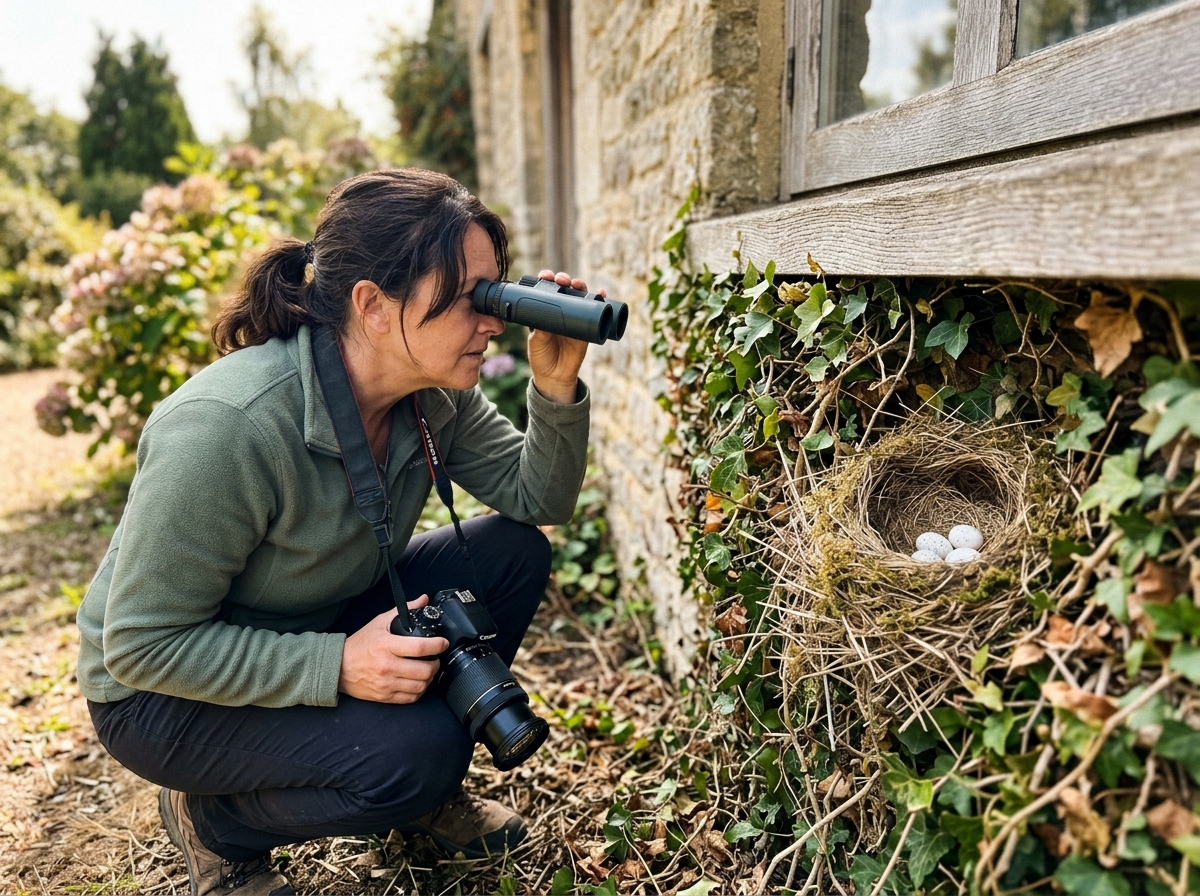
Before you make any decision, you need to know what kind of nest you're looking at, whether it's active, and whether eggs are present. This isn't just curiosity: it determines what the law requires, what the risks are, and what your options look like.
Identifying the nest type and species
Use a combination of cues: nest size and shape, materials used, placement, and any birds you see nearby. A cup-shaped nest of woven grasses and mud about 3 to 5 inches across tucked into a tree fork is likely a robin or thrush. A compact nest of plant fibers, lichen, and spider silk under 3 inches wide is typically a hummingbird or small warbler. A large stick platform 2 feet or more across in a tall tree or on a utility structure is almost certainly a raptor (hawk, osprey, or eagle). A ground-level scrape with pebbles or plant debris could be a killdeer or other shorebird. Behavior matters too: watch from a distance of at least 30 feet and note whether adult birds are approaching or circling.
If you can photograph the nest and any nearby birds without approaching closely, do it. A photo from 10 to 20 feet away with a phone or camera is usually sufficient for identification. Apps like Merlin (Cornell Lab) can help identify birds by appearance or sound. Field guides organized by nest type and habitat are also useful. The goal is to pin down the species before you do anything else, because a robin's nest and an eagle's nest have very different legal implications.
Checking for eggs without disturbing the nest
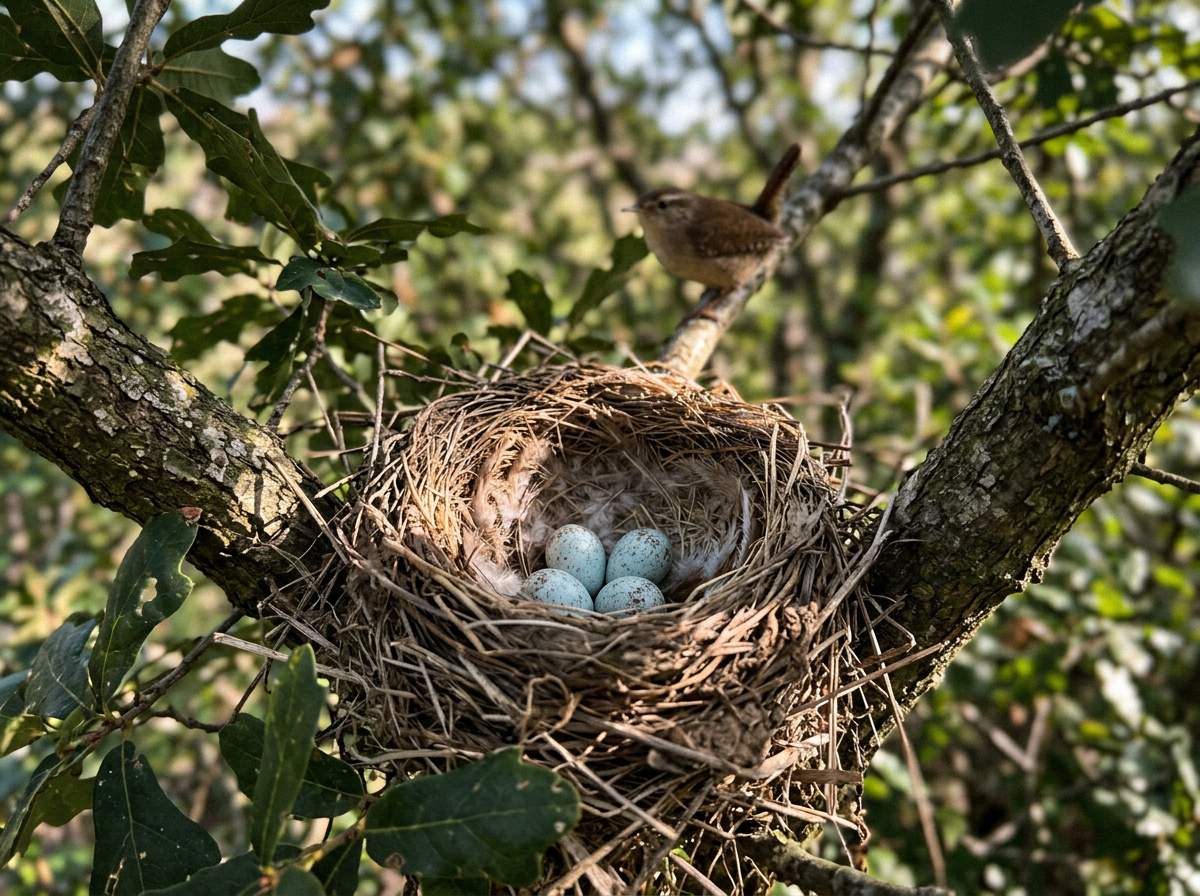
If the nest is accessible and you can see inside without touching it or displacing a sitting bird, look carefully. Eggs in most songbird nests are small (roughly 0.5 to 1 inch long), often speckled or blue, and usually sit in a tight clutch of 2 to 6. If a bird is sitting in the nest and does not move when you approach slowly, do not try to force it off. That is a clear sign the nest is active. NestWatch's code of conduct is explicit: never force a sitting bird off the nest. If you're not sure whether the nest has eggs or is empty, assume it might have eggs and treat it accordingly.
One important point: even a nest that looks inactive or abandoned may still have viable eggs. Incubation pauses are normal (some birds don't begin full incubation until the clutch is complete), and eggs can survive short periods without a parent on them. Don't assume a nest is abandoned just because you don't see a bird on it for a few hours.
Before eggs vs. after eggs: what actually changes
This is the most practically useful distinction to understand, because your window of options narrows dramatically once eggs appear.
| Situation | Legal Status | Practical Risk | Best Option |
|---|---|---|---|
| Nest under construction, no eggs | Generally lower risk; nest not yet "active" but species still protected | Low: birds may abandon and rebuild naturally | Remove or relocate now if you must, before eggs appear; do it quickly |
| Nest complete, no eggs yet | Nest is protected; eggs may be laid any day | Medium: eggs could appear within days; removal now avoids future conflict | Act immediately if removal is needed; once eggs appear, your options disappear |
| Nest with eggs present | Fully protected under MBTA; handling without permit is illegal | High: disturbance can cause abandonment, temperature loss in eggs, predation | Do not move; call a wildlife rehabilitator or USFWS for guidance |
| Nest with chicks present | Fully protected; MBTA applies to live young too | Very high: chicks are fragile and dependent on parents | Do not move; protect the area and wait for fledging |
| Inactive/empty nest (breeding season over) | Nest may no longer be protected once confirmed inactive and season has passed | Low: if truly inactive, no direct harm to birds | Safe to remove carefully; confirm inactivity first |
The clearest window for intervention is before eggs are laid. If you find a nest under construction on your porch, gutters, door wreath, or HVAC equipment and no eggs are present, you have a brief and legal opportunity to discourage nesting by gently removing the nest materials and deterring the birds from returning to that spot. Once eggs appear, that window closes and you're in legally protected territory.
For nests that are complete but not yet containing eggs, act quickly. Birds can lay the first egg within a day or two of finishing the nest structure. If your situation genuinely requires the nest to be removed (and the species is not one with additional protections like eagles), removing it now is far less harmful and legally complex than waiting.
When moving is off the table: common scenarios and what to do instead
Most of the situations that push homeowners toward wanting to move a nest are ones where moving is either illegal, ineffective, or both. Here are the scenarios that come up most often.
Nest in a high-traffic or inconvenient location
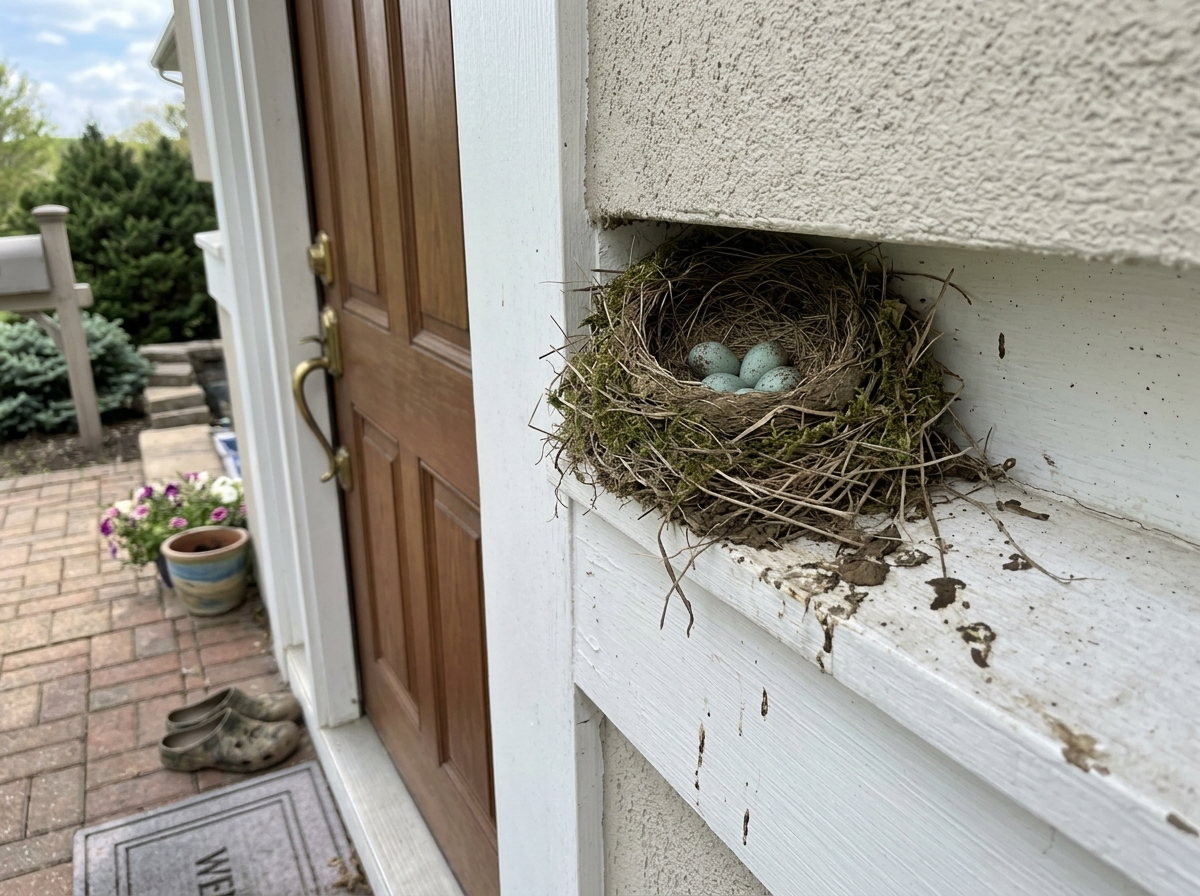
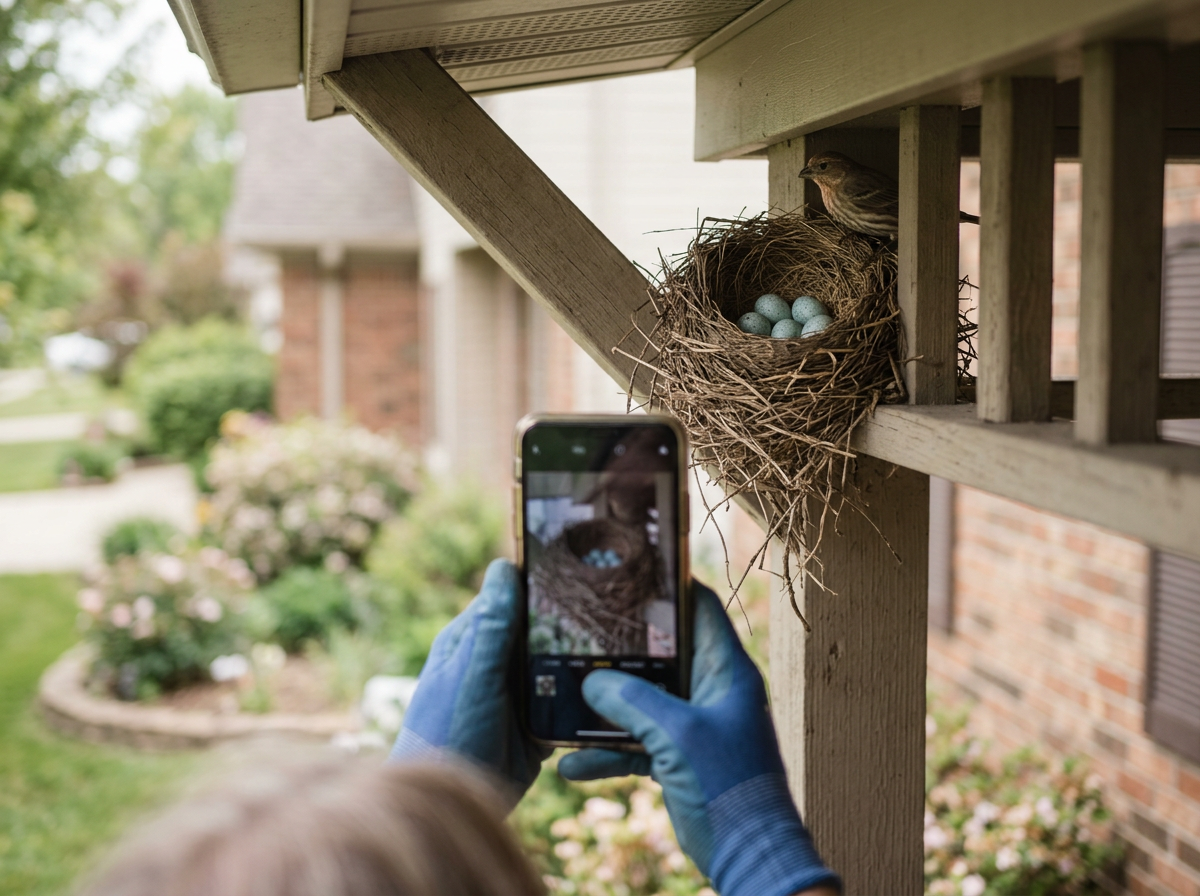
A robin built a nest above your front door. A house finch is raising chicks in your hanging basket. A mourning dove is sitting on your outdoor table. If there are eggs or chicks, you cannot legally move the nest, and moving it risks abandonment. The practical solution is to redirect human traffic rather than the birds, if you’re thinking, “can you move bird nests” because a nest is in an inconvenient spot, this is usually the right approach. Temporarily block off the door or area with a simple sign or physical barrier, reroute foot traffic, and ask household members not to use that entrance for the 2 to 3 weeks it typically takes for eggs to hatch and chicks to fledge. It's a minor inconvenience compared to the legal and ethical alternative. where to move a bird nest with eggs. what happens if you move a bird nest
Nest in a safety-critical location
If the nest is inside active machinery, a dryer vent, or somewhere that poses a genuine fire or safety hazard, this is one of the very limited situations where the USFWS acknowledges that removal may be justified. Even then, the agency's guidance says a nest should only be removed if it poses a real risk to human health or safety, and going through proper channels is still required. Contact your state wildlife agency or a USFWS regional office before taking any action. Do not assume that "it's a safety issue" automatically gives you permission to act.
Nest on property being sold, rented, or renovated
Construction timelines do not override federal wildlife law. The USFWS is clear that destruction of active nests as a byproduct of clearing or construction work falls under MBTA violations. If you have a project starting soon and there's an active nest on-site, the recommendation is to delay the work in that specific area until the nest is confirmed inactive (all eggs hatched, all chicks fledged and gone). This is often the only compliant option, and it's also the one that professional contractors working near natural habitats are already required to follow.
Nest from a non-native species
House sparrows and European starlings are not protected by the MBTA because they are non-native, invasive species. If you have confirmed the nest belongs to one of these species (not just guessed), you have more legal flexibility to remove it even if it contains eggs. However, confirming the species with certainty before acting is essential. Misidentifying a protected species as a house sparrow can still result in a violation. When in doubt, contact a wildlife professional for confirmation.
When moving might be permitted: a step-by-step process
There are rare situations where nest relocation is authorized: confirmed non-native species, a nest that has been determined inactive and the season is clearly over, or a scenario where a USFWS permit has been obtained (typically for commercial or research contexts). Here is how to handle relocation responsibly in cases where it's genuinely allowed.
- Confirm the nest is either from a non-native species or is truly inactive (no eggs, no chicks, no adult activity for several days in late season). Photograph the nest and any birds before touching anything.
- Choose a relocation site within 10 to 15 feet of the original location if possible. Birds that might return to an empty nest will look in the immediate area. Put it at a similar height and orientation, in a sheltered spot protected from direct sun and prevailing wind.
- Wear thin disposable gloves to avoid leaving scent on the nest. The old myth that birds abandon nests if humans touch them is mostly false for songbirds, but gloves are still a good habit and protect you from parasites that often live in nests.
- Support the nest from below with both hands. Do not grip the sides or compress it. Move slowly and steadily.
- Secure the nest at the new location using a shallow basket, platform, or forked branch that mimics the original support. Do not tie or fasten the nest itself.
- Back away immediately and observe from a distance. If parents are present, watch whether they return to the new location within an hour or two.
- Do not check or touch the nest again for at least 3 to 4 days. Repeated visits are the main cause of stress-related abandonment.
Even in permitted or low-risk scenarios, relocation carries real abandonment risk. USFWS and NWRA guidance both note that relocation is only considered where it has a reasonable chance of success and that Service biologists should be consulted when there's any uncertainty. If you're not certain the situation qualifies, make a call before you make a move.
Keeping eggs viable and parents coming back
If you're in a situation where the nest has been disturbed (not by you, but by a storm, predator, or other event) and you're trying to stabilize things without relocating the nest, here is what actually matters.
Temperature and exposure
Eggs are sensitive to temperature. Most songbird eggs need to be kept at roughly 98 to 100 degrees Fahrenheit during incubation. If the nest has been knocked out of its original position but is still close by and the eggs are intact, carefully returning the nest to its original spot (or as close as possible) gives the parents the best chance of resuming incubation. If eggs have been fully exposed to cold air for more than a few hours, viability is uncertain, but returning them to the nest and allowing the parents to assess the situation is still the right move. Do not attempt to incubate eggs yourself without professional guidance.
Cover and predator protection
If the nest is now exposed to predators or weather because a branch broke or a structure shifted, you can provide some protection without moving the nest. A loose piece of natural material (a branch leaned nearby, a small section of burlap or natural fabric draped over the area but not touching the nest) can reduce exposure. Keep any cover loose enough that parents can enter and exit freely. Don't create a box or enclosure that traps or confuses them.
Monitoring without crowding the nest
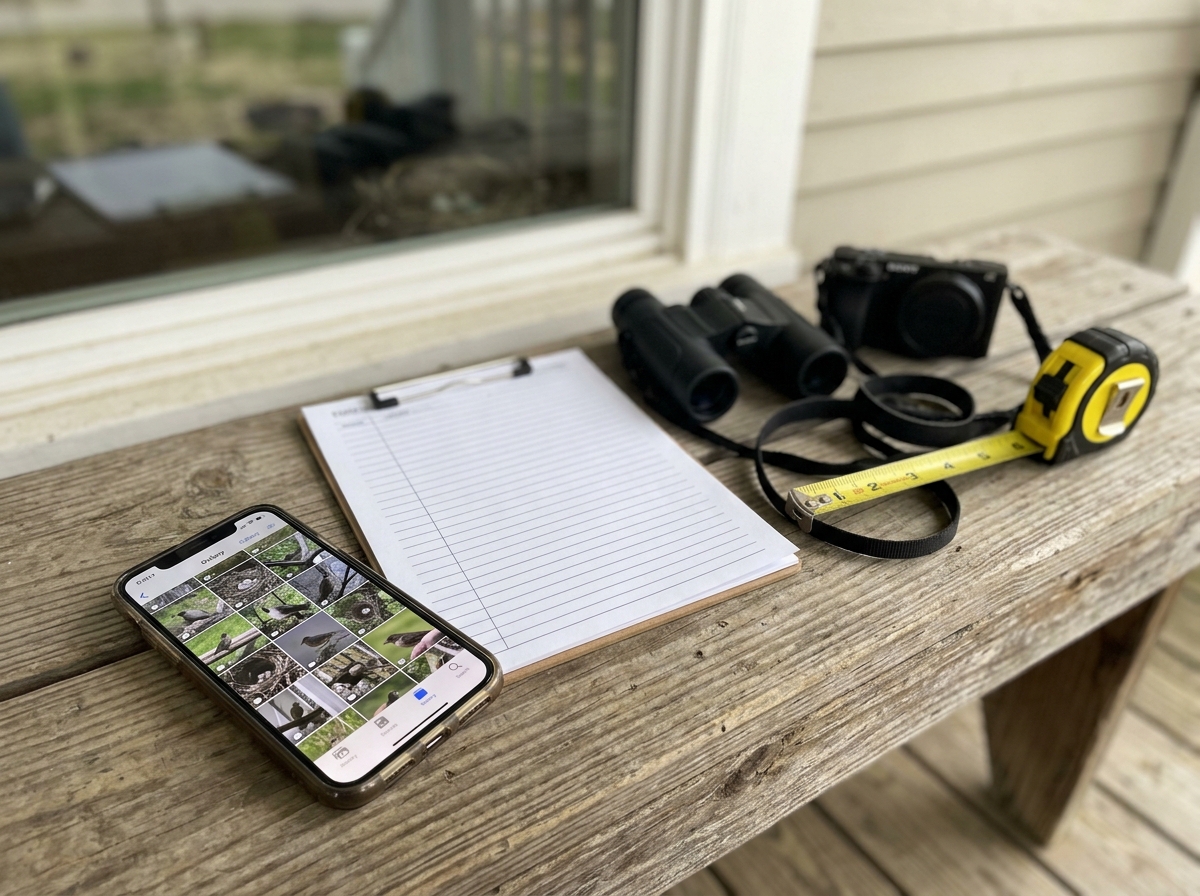
The best monitoring approach is brief and infrequent. NestWatch recommends checking every 3 to 4 days rather than daily visits. Each check should take less than 30 seconds. Approach slowly, note what you see (number of eggs, whether a bird is present, any changes), photograph if possible from the same angle each time, and leave. If you are tracking nest activity for documentation purposes, a simple notebook log works well: date, time, observed status, weather. This record is also useful if you end up needing to contact a wildlife agency.
What to do right now: calls, documentation, and prevention
Who to contact
If you have an active nest with eggs and a genuine conflict (safety hazard, project deadline, injured adult bird), your first call should be to a local licensed wildlife rehabilitator. The National Wildlife Rehabilitators Association (NWRA) and the Wildlife Center of Virginia both maintain searchable directories. Your state's fish and wildlife or natural resources agency is the next stop: they can tell you what permits apply in your state and whether any exceptions exist for your situation. For federal permit questions (especially anything involving raptors or eagles), contact your USFWS regional migratory bird office directly.
Animal control is generally not the right call for nest conflicts. Most animal control officers handle domestic animals and do not have authority or training for migratory bird situations. A wildlife rehabilitator or state natural resource agency officer is the appropriate expert.
What to document before you call
- Photos of the nest from multiple angles, including its location on the structure or tree
- Photos or video of any adult birds visiting the nest (helps with species ID)
- Approximate nest dimensions (width, depth) and height from the ground
- Date you first noticed the nest and whether construction, eggs, or chicks were present
- A description of the conflict: why you're concerned and what the risk or inconvenience is
- Any observed adult bird behavior: flushing, vocalizing, feeding young
Having this information ready will make any call to a wildlife agency or rehabilitator much faster and more productive. It also protects you: if you document that you contacted the appropriate authorities before taking any action, you have a record of good-faith effort.
Preventing the same conflict next season
The most effective time to address a nest location problem is after the current nest is inactive, before birds return in the spring. Once chicks have fledged and the nest is confirmed empty (typically by late summer or fall), you can remove the nest material and modify the site to discourage future nesting. This might include installing physical deterrents like sloped boards or spikes on ledges, sealing holes or gaps in eaves and soffits, covering dryer or bathroom vents with appropriate mesh, or adding moving elements (like wind chimes or reflective tape) near preferred perching spots. None of these are perfect, but a combination of deterrents applied in late fall (when birds aren't actively nesting) gives you the best chance of redirecting them next season without a repeat conflict.
If you want birds nearby but just in a better spot, installing a nest box appropriate for your local species (bluebird boxes, wren houses, or martin gourds depending on your region) gives birds a sanctioned alternative. Placing it 20 to 30 feet from the problem location and in the right habitat may redirect nesting behavior naturally. This kind of proactive approach, planning for next season while the current one runs its course, is really the most conservation-friendly and practical path forward for most homeowners.
FAQ
What if I do not see the bird sitting on the nest, but eggs might still be there? Can I move it anyway?
If you see eggs, the safest assumption is that the nest is active and protected, even if the bird is momentarily away. Treat it as active until you have confirmation that all chicks have fledged and the nest is truly empty.
How can I tell if a nest is really abandoned before touching it?
Do not. Even moving empty or “abandoned-looking” nests can become illegal if eggs are still viable or if a hidden parent returns and resumes incubation. The practical way to check is to photograph the nest, then wait until the nest has been inactive for long enough to confirm it is empty (typically after the nesting season, not just a single afternoon).
If my intention is only to scare the birds away, is it still illegal to touch or move the nest with eggs?
In general, no. MBTA risk comes from disturbing or moving nest material and eggs, not from the intent. “I only touched the nest” can still count as handling or disturbing, especially when eggs or chicks are present.
What should I do if the nest with eggs is in a vent, wall, or other inaccessible spot?
If the nest is inside a vent, behind siding, or in a tight cavity, you should avoid DIY removal, because it often causes egg death or abandonment and can make the situation worse. Instead, contact a wildlife rehabilitator or your state wildlife agency first, they can tell you whether exclusion or delay is the right approach and what timelines apply.
Can I use spikes, netting, or reflective tape while the nest still has eggs?
Yes, deterrents can be used only when there are no eggs or active nesting, for example after chicks have fledged and you have confirmation the nest is empty. If you apply deterrents during an active period, you can trigger abandonment or predation and still create legal exposure.
If relocation would save the nest, can I get a permit and move it legally?
Relocation is sometimes allowed only under specific conditions, for example verified non-native species, confirmed inactive nests during the appropriate season, or when a permit specifically authorizes it. For most homeowners, even “successful” relocation is not something you should attempt without explicit authorization.
What if the nest fell from a branch during a storm, can I put it back where it was?
The “best chance” approach is not to move the nest, instead protect from additional harm and allow parents access. If the nest was knocked loose but eggs are intact, returning it close to its original placement can help, but do not improvise incubation or enclosures that block entry and exit.
How long should I block an entrance or redirect foot traffic around an active nest?
Keep barriers and reroutes in place only as long as needed, typically until hatch and fledging are complete, then reassess. A common practical mistake is removing barriers too early, which can lead to repeat nesting attempts or conflicted disturbance.
If I think the nest is a house sparrow or starling, can I remove it with eggs to stop the problem?
European starlings and house sparrows have different protections because they are non-native invasive species, but you must be confident in identification. Misidentifying a protected native species is a common error, so if you are not certain, get a wildlife professional or agency to confirm before acting.
Who should I call if I need help with a nest with eggs in my yard, animal control or wildlife services?
Animal control is usually not the right channel for migratory bird nest conflicts, because their typical mandate is domestic animals and they may not be equipped to advise on MBTA compliance. The more effective first step is a licensed wildlife rehabilitator or your state fish and wildlife agency.
What if I have construction scheduled soon, can contractors proceed if they avoid the nest area temporarily?
If a nest is threatened by scheduled construction, the compliant path is usually to pause work in that specific area until the nest is confirmed inactive. Trying to “work around it” without coordination can still disturb adults or eggs, and construction timing does not override federal protections.
If I call an agency, what information should I provide, and should I take the eggs out for better documentation?
The right approach is to document from a distance and log what you observe, but do not handle eggs or clean out the nest. If you end up needing agency advice, your notes (date, time, number of eggs or chicks, weather) help them determine whether you are dealing with an active nesting stage or a post-season situation.
Next Article
What Happens If You Move a Bird Nest and What to Do
What happens if you move a bird nest, how to spot active nests, and safe legal next steps.