Here is the short answer: in most cases in the U.S., you legally cannot move a bird nest that contains eggs without a federal permit. The Migratory Bird Treaty Act (MBTA) protects the eggs, nests, and birds of roughly 1,100 native species, and moving an active nest without authorization can carry criminal penalties. That said, there are rare situations where a careful, minimal relocation is the most humane option, and understanding when you are and are not in one of those situations is the whole game. This guide walks you through the triage, the rules, and, if relocation is genuinely appropriate, exactly how to do it. can you move a bird nest with eggs
Where to Move a Bird Nest With Eggs: Safe Steps

Maya Bennett
22 Mar 2026
First: should you move this nest at all?
Before you touch anything, stop and ask three questions. Is the nest currently active (meaning it has eggs or live chicks)? Is there an immediate, concrete danger to the nest or the eggs, such as a construction cut scheduled for this week, a predator actively raiding the site, or a structural collapse risk? And is the species involved a protected migratory bird, or is it a non-native species like a European starling or house sparrow, which are not covered by the MBTA?
If the nest is active and the bird is a native species, your default position should be to leave it alone and protect the immediate area until the eggs hatch and the young fledge. Most backyard nest situations, even ones that feel urgent, fall into this category. If there is no immediate structural or safety threat, the best thing you can do is mark off a two-to-three foot buffer around the nest, limit foot traffic, and wait. Breeding cycles for common songbirds run 10 to 28 days from incubation to fledging, so the timeline is usually manageable.
Use this quick triage to sort your situation:
| Situation | Recommended Action |
|---|---|
| Active nest, no immediate danger | Leave it. Buffer the area and monitor from a distance. |
| Active nest, construction/demolition imminent this week | Contact a licensed wildlife rehabilitator or your regional FWS office immediately. |
| Active nest, non-native species (starling, house sparrow) | Legal to remove in the U.S., but confirm species ID first. |
| Active nest, cat or predator actively raiding | Add predator deterrents (see below); do not move unless professional advises. |
| Empty nest, breeding season over | Can usually be removed without legal issue; check local rules. |
| Nest with eggs, fallen from original site | Replacement in same or nearest safe location is the most defensible option; contact rehabilitator for guidance. |
Legal and ethical rules you need to know
In the United States, the MBTA makes it unlawful, unless permitted by regulation, to take, possess, transport, or otherwise handle a migratory bird or any part, nest, or egg of such a bird. Violations can be treated as criminal misdemeanors. The U.S. Fish and Wildlife Service states plainly that it is illegal to destroy a nest that has eggs or chicks in it, and that nest removal permits are usually only issued when a nest poses a human health or safety concern or when the birds are in immediate danger. This is a high bar. "My porch light is inconvenient" does not meet it.
In the UK, the Wildlife and Countryside Act 1981 offers equivalent protection. The RSPB advises that disturbing nesting birds should be avoided at all costs, and the RSPCA warns that you may face prosecution if you disturb or remove a nest during active use. Canadian guidance under Environment and Climate Change Canada similarly prohibits removing or damaging nests unless legal exceptions or permits apply.
The ethical dimension goes beyond the legal one. Moving a nest with eggs introduces real risks: chilling eggs (even 20 to 30 minutes of exposure can be fatal at temperatures below about 70°F), disrupting the adult's ability to find the nest, and attracting predator attention through scent and disturbance. When Audubon advises contacting a wildlife rehabilitator rather than attempting relocation yourself, it is not being overly cautious. It is reflecting real egg-survival data.
The practical ethical rule: if you are uncertain whether the situation qualifies as an emergency, treat it as one that requires professional consultation, not DIY action.
Identify the species and nest type before you decide anything
Knowing what you are dealing with changes everything. A house sparrow nest (not protected by the MBTA) in your dryer vent is a very different situation from an American robin nest (fully protected) in your hanging planter. Spend two or three minutes on identification before you make any decision. NestWatch teaches that nest shape combined with nesting materials are the most reliable diagnostic cues.
The main nest types
- Cup nest: The most common type for backyard songbirds. A rounded, open bowl typically made of grasses, plant fibers, mud, or bark strips, placed in a shrub fork, tree branch, or on a ledge. American robins, house finches, and mourning doves all build variations of this. Size ranges from about 3 inches (hummingbirds) to 6 to 8 inches (robins) in diameter.
- Cavity nest: Built inside a hole, either natural or excavated. Think woodpeckers, bluebirds, and chickadees. The cavity itself is the structure; the nest inside is usually made of grasses, feathers, or moss. If you are looking at a hole in a tree or nest box, this is likely what you have.
- Scrape nest: A shallow depression on the ground with minimal material added. Killdeer are the classic example, often nesting directly on gravel driveways or flat rooftops. Eggs are camouflaged and sit directly on or just below ground level.
- Platform nest: Large, flat structures built by raptors (hawks, ospreys, herons) or crows in treetops or on structures. These can be enormous, sometimes over 3 feet across, and reused across seasons.
- Pendant or woven nest: Long, hanging pouches woven from plant fibers, typical of orioles. Usually suspended from a branch tip over open space.
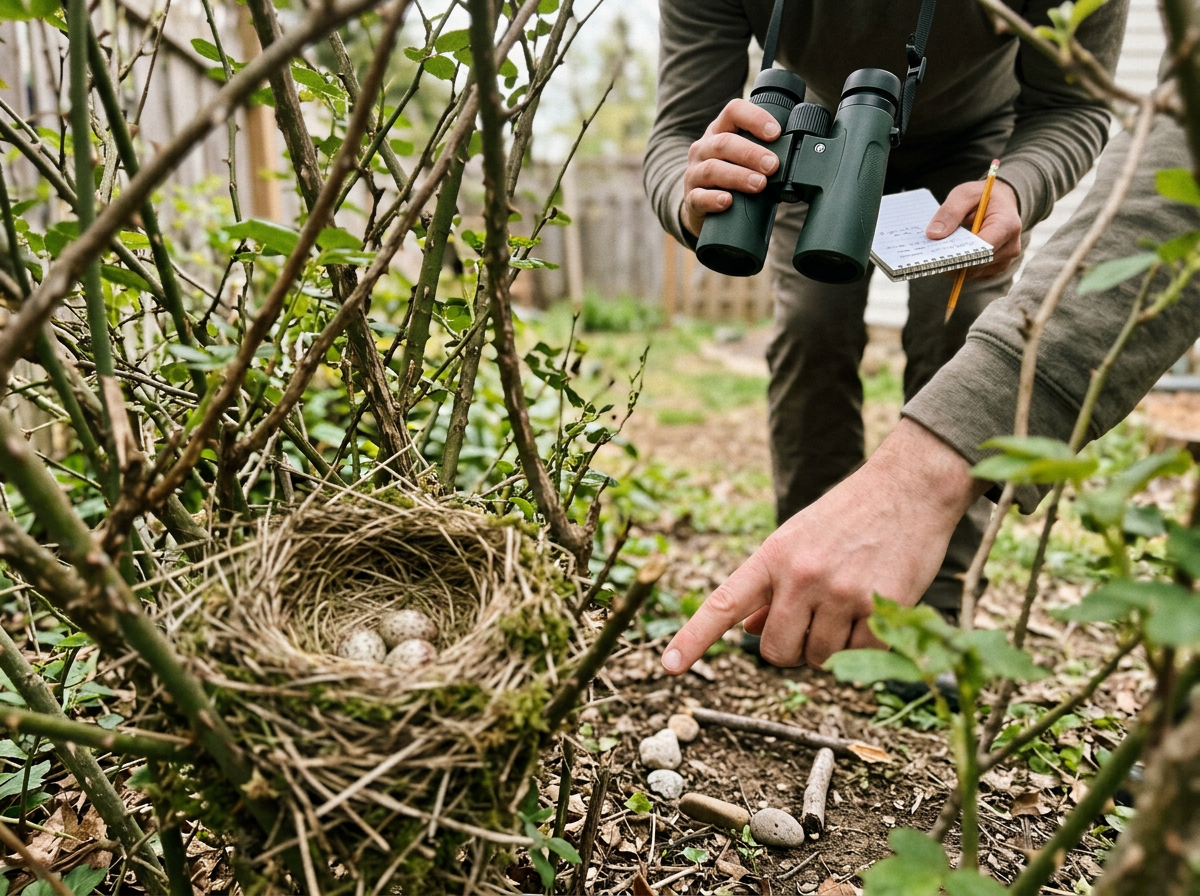
To identify the species, use the nest type, location, and materials together. A small cup nest of dried grass and mud in a rose bush is almost certainly a robin or house finch. A woven pouch hanging 20 feet up from an elm branch is almost certainly a Baltimore oriole. Once you have a likely species, cross-check whether it is on the MBTA protected list (virtually all native U.S. birds are) or whether it is a non-native species exempt from protection. The Mass Audubon Bird Nest Finder and NestWatch are both excellent free identification tools for this step. Take a photo of the nest, its location, and the eggs before you do anything else.
Where to move the nest: picking the right spot
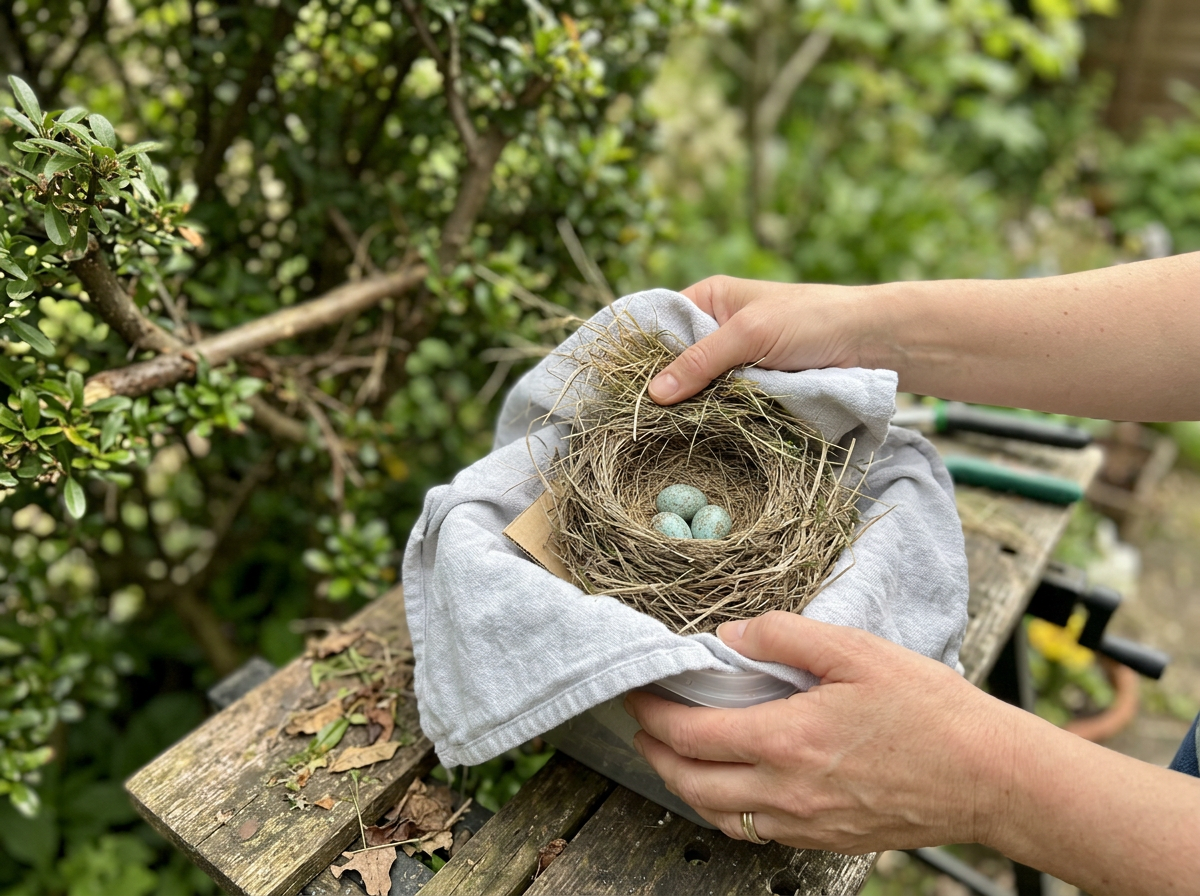
If you have determined that relocation is legal and genuinely necessary (a fallen nest, a permitted safety scenario, or a non-protected species nest you are allowed to move), the placement decision is critical. The guiding principle is: as close to the original location as physically possible, matching the original orientation and cover as closely as you can.
The returning adult bird navigates by visual landmarks. If you move a cup nest from a porch rafter 10 feet to an adjacent shrub, the adult will likely find it. If you move it 40 feet around the corner and out of sight of the original spot, the chances of reunion drop sharply. Aim to stay within 10 feet of the original site if you can, and never more than about 15 to 20 feet away.
Checklist for a good replacement site
- Within 10 to 15 feet of the original nest position, ideally in the same sightline.
- At the same or similar height. If the original nest was 6 feet off the ground, replicate that as closely as possible.
- Covered from above. Eggs exposed to direct sun can overheat in as little as 30 minutes on a warm day. Look for leaf cover or partial shade.
- Hidden from open sight lines. Placing a nest in the open invites crow and jay predation. Tuck it into a fork or behind foliage.
- Stable and secure. The nest must not rock or tip. Use a small wicker basket, a cut-down berry carton, or a purpose-built nest cup to cradle and stabilize it if needed.
- Away from areas of high foot traffic or repeated human disturbance.
- As close to the same compass orientation as the original (if you know it). Many species orient their nests to avoid prevailing wind or morning sun.
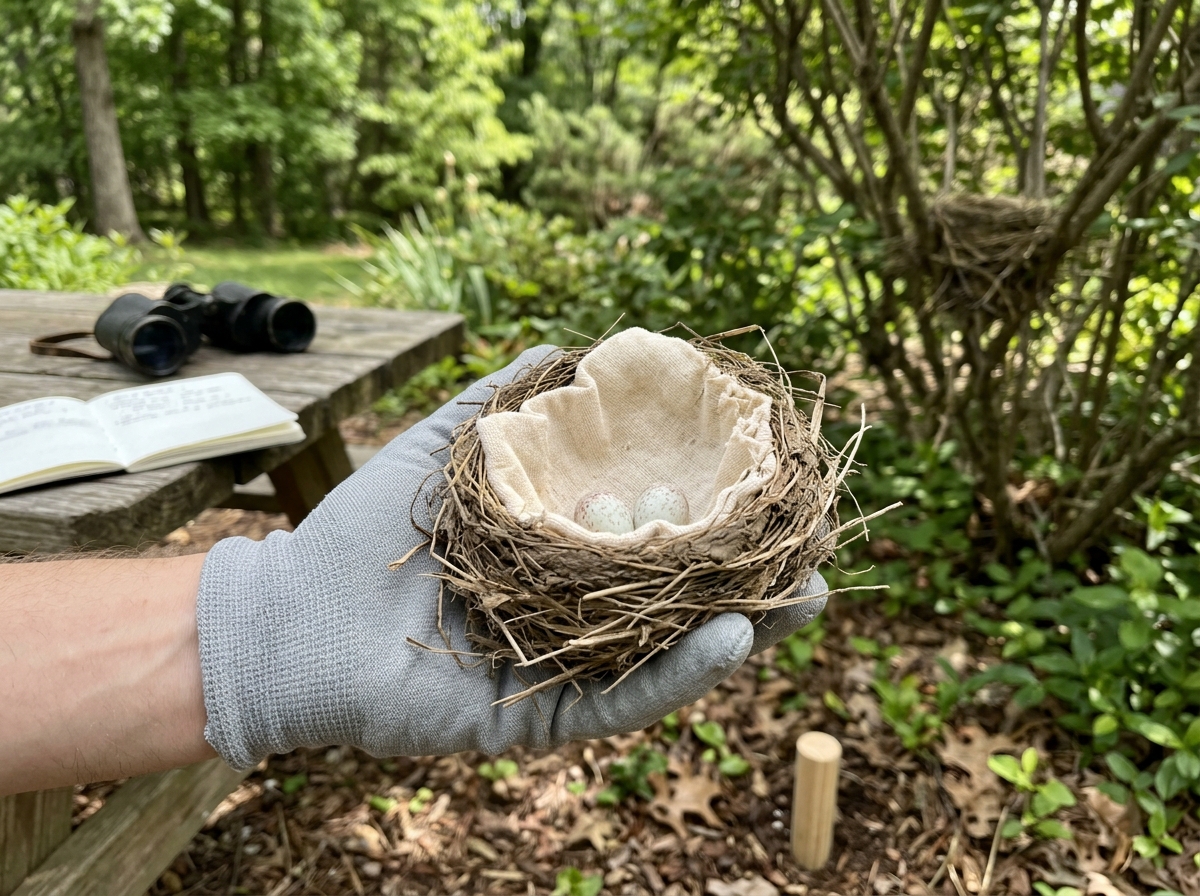
For a fallen nest specifically, your first priority is to get it back up into the original tree or shrub it came from, at roughly the height it was before. Use a small berry basket or a plastic cup with drainage holes punched in the bottom as a cradle, tuck the original nest inside it, and wire or tie it securely to a branch fork. This is the method most wildlife rehabilitators recommend for displaced nests, and it has a meaningful success rate when done quickly.
Step-by-step: how to actually do the relocation
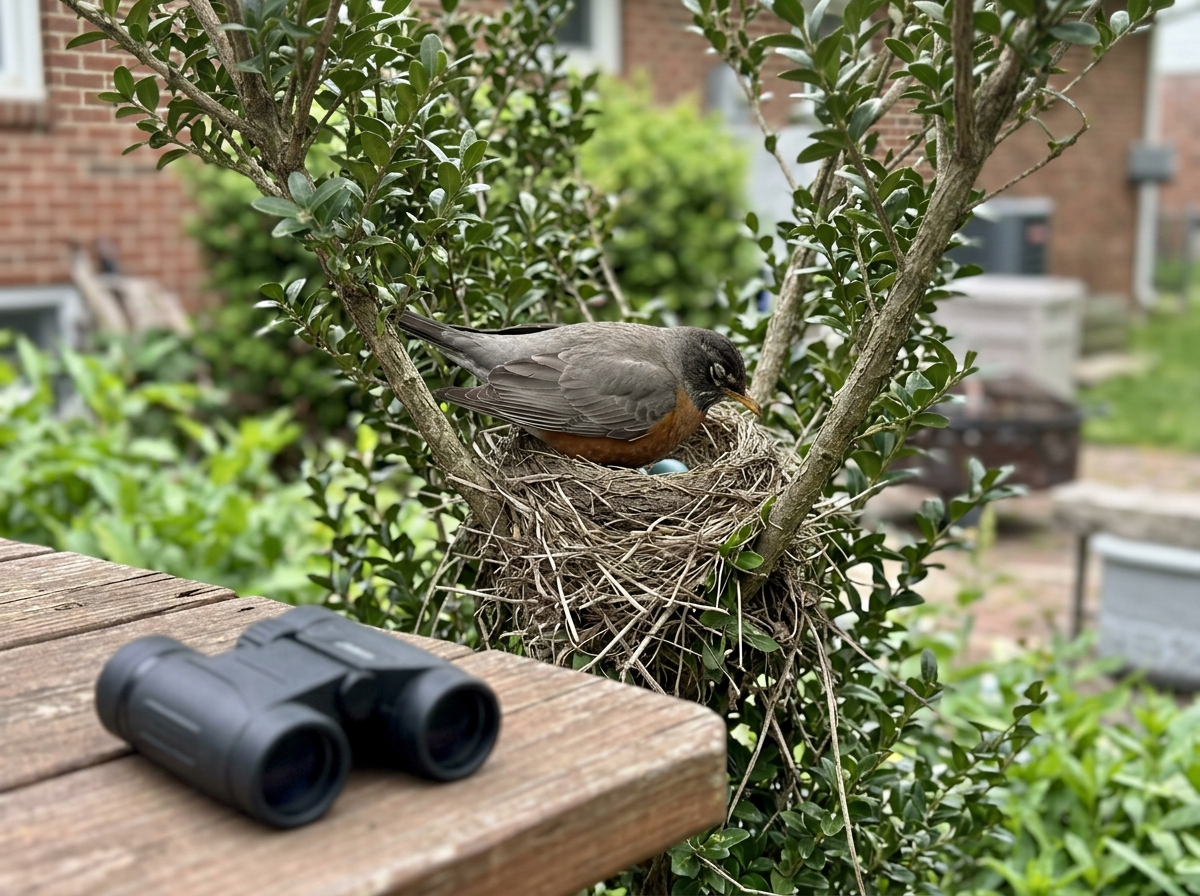
If you have cleared the legal and ethical bar and you are ready to move the nest, work through these steps methodically. Speed and minimal handling are everything.
- Time it right. Relocate in early morning when temperatures are cool and the adult is most likely to be foraging nearby rather than incubating. Never move a nest in the heat of midday.
- Wash your hands or put on clean gloves. The myth that birds will reject eggs touched by humans is largely false for most species, but you still want to minimize contamination and scent that could attract predators.
- Photograph the original position before touching anything. Note the compass direction the nest cup faces, the height off the ground, and what the nest is resting on or in.
- Prepare your receiving site before you pick up the nest. Get your basket or cradle secured at the destination so the transfer takes less than 60 seconds.
- Lift the nest from underneath with both hands, keeping it level at all times. Do not tilt it. Eggs are not glued in place and will roll.
- Move directly and smoothly to the new site. Do not stop, do not detour, do not let children or bystanders handle it.
- Place the nest into the cradle or directly into the fork, replicating the original orientation as closely as possible. Press it gently to confirm it is stable and will not rock.
- Step back immediately. Walk at least 30 feet away and stop all activity near the site.
- Begin monitoring from a distance. Give the adult at least two to four hours to return before drawing any conclusions.
The whole process from lift to placement should take under two minutes if you have prepared the receiving site in advance. The biggest mistakes people make are hesitating during transport (exposing eggs to cold or sun too long) and crowding the new site with observers afterward.
After the move: monitoring, predator protection, and what success looks like
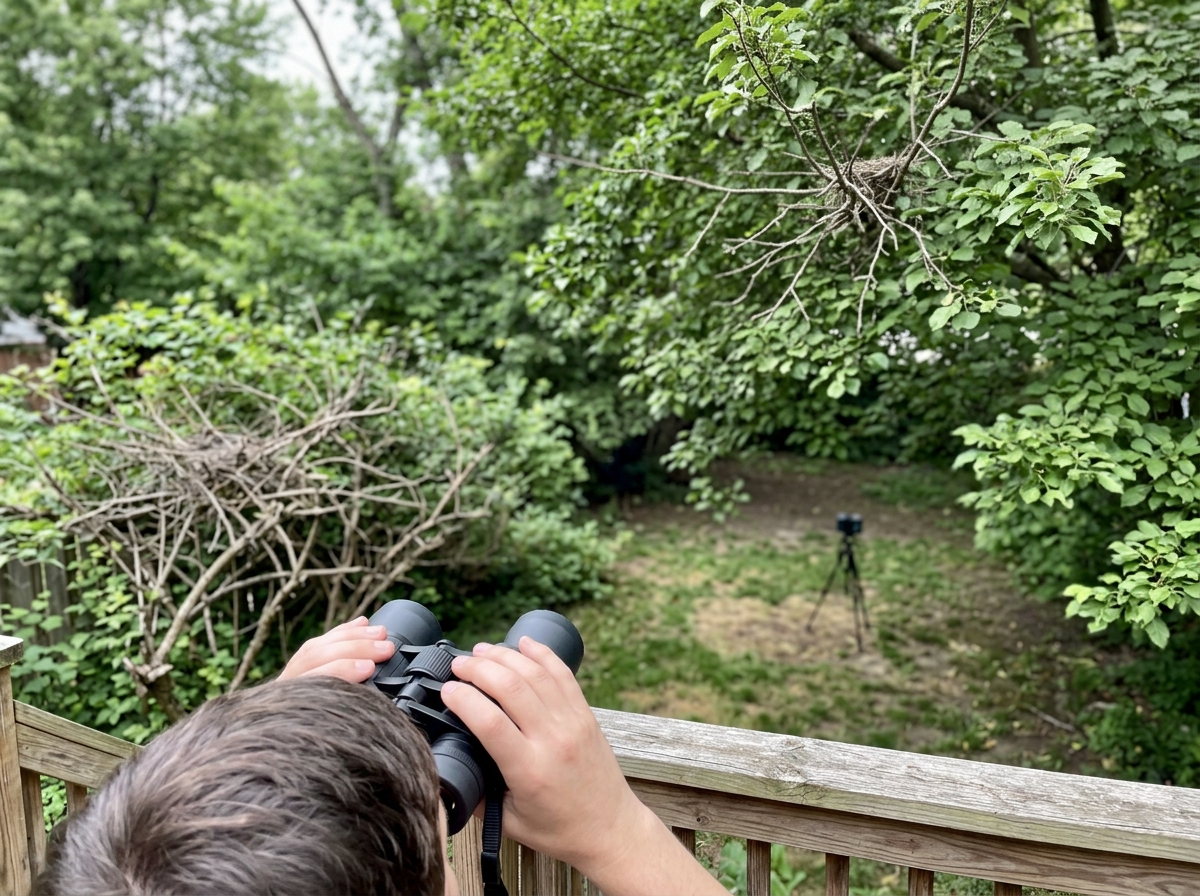
Once the nest is in place, your job shifts to patient observation. Use binoculars from at least 20 to 30 feet away, or set up a position inside your home with a clear sightline to the new location. Check twice a day, morning and late afternoon, and note what you see.
Signs the relocation worked
- Adult bird returns to the new nest within four hours of relocation.
- Adult resumes incubation behavior: sitting low in the cup, rarely leaving for more than 15 to 20 minutes at a time.
- You can hear the adult vocalizing near the new site.
- No eggs are found displaced from the nest in the first 24 hours.
Predator deterrence at the new site
Relocation can temporarily disrupt the adult's territorial defense, making eggs more vulnerable in the first day or two. Add some passive protection immediately. A ring of prickly plant clippings (rose, hawthorn, holly) placed loosely around the base of the bush or under the nest site creates a physical barrier against ground predators. If cats are active in your yard, a motion-activated sprinkler placed near the new site is the single most effective deterrent and does not harm the birds. Avoid reflective tape or wind chimes near the nest itself, as these can spook the returning adult.
Do not place any kind of birdhouse or enclosure over an open cup nest after relocation. It changes the profile the adult recognizes and adds handling stress. Keep modifications simple and passive.
What the monitoring timeline looks like
| Timeframe | What to look for | What it means |
|---|---|---|
| 0 to 4 hours | Adult returns and sits on nest | Relocation likely successful |
| 4 to 12 hours | Adult present but nervous, calling from nearby perches | Normal adjustment; keep area quiet |
| 12 to 24 hours | No adult seen near nest at all | Concerning; contact a rehabilitator |
| 24 to 48 hours | Adult back on nest, incubating normally | Success; continue monitoring from distance |
| Eggs hatch (10 to 28 days depending on species) | Adult bringing food to nest | Full success; fledging will follow in 10 to 20 more days |
Troubleshooting and when to call in the professionals
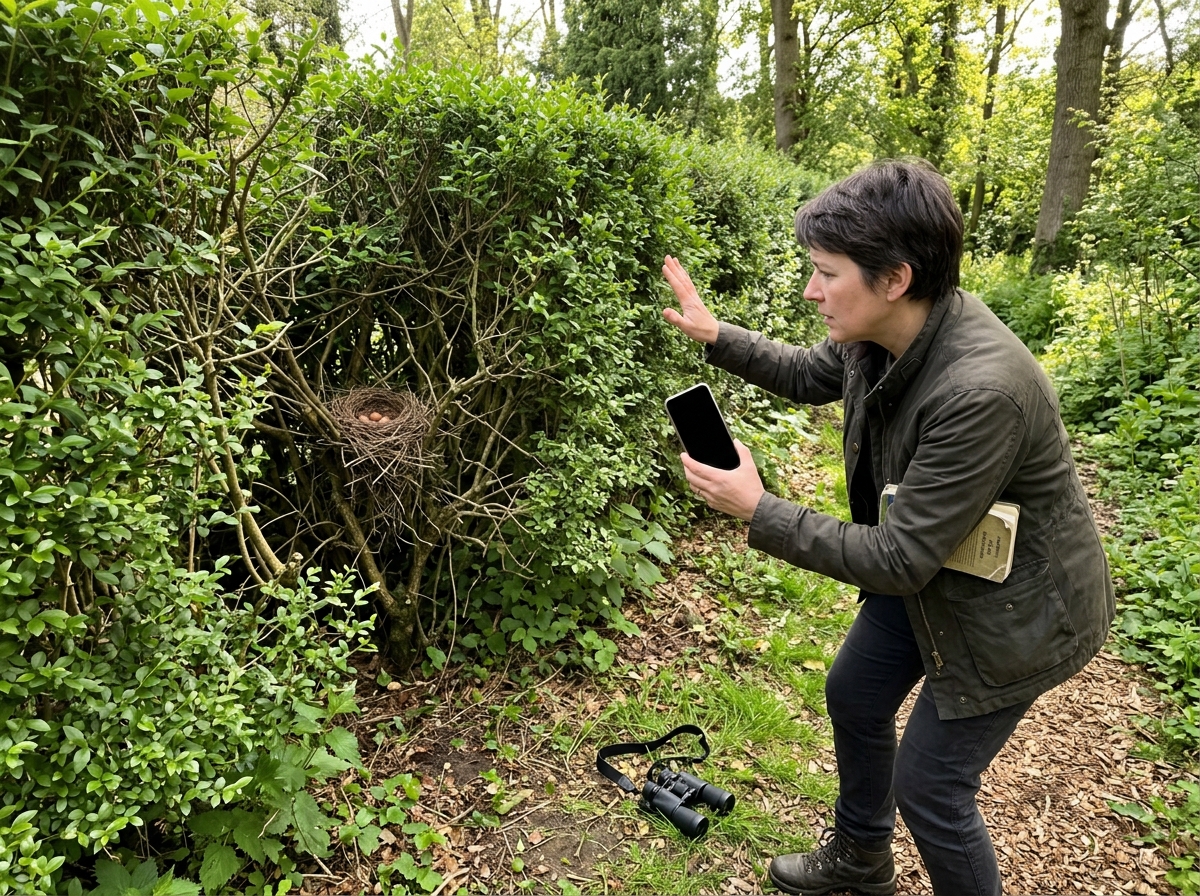
Even well-executed relocations sometimes go sideways. Here is how to handle the most common problems.
The adult bird has not returned after 12 hours
Twelve hours without an adult returning to incubate in cool or mild weather is a serious sign. Eggs need to be kept at roughly 99 to 100°F during incubation, and even a few hours of cold exposure can kill an embryo. Do not attempt to incubate eggs yourself with a heating pad or lamp unless a licensed rehabilitator has specifically told you to and explained how. Call your nearest licensed wildlife rehabilitator immediately. You can find one through the National Wildlife Rehabilitators Association (NWRA) or through your state's fish and wildlife agency.
The adult returned but seems agitated and will not settle
This is normal for the first several hours after a disturbance. Keep all humans and pets well away from the site. If you have recently been walking near the nest, stop entirely. The adult may pace nearby branches, alarm-call repeatedly, and make several approaches before committing. Give it a full day before concluding there is a problem.
Eggs are on the ground under the new nest site
This usually means the nest cradle tipped or the nest was not stable. Gently replace the eggs and re-secure the nest immediately. Check that it cannot rock in any direction. If you see this happen twice, the site itself is not working and you need to find a sturdier branch fork or use a more secure cradle.
You moved the nest and now realize you should not have
This happens. If you acted hastily and the nest was legally protected and you have moved it without a permit, the pragmatic next step is to contact a licensed wildlife rehabilitator, explain what happened, and ask for guidance on recovery. Rehabilitators are not enforcement agents and their priority is the same as yours: getting those eggs to hatch. They can advise on whether the eggs are still viable and what to do next. Do not try to cover the situation up by moving the nest again.
When to stop trying to manage it yourself
Contact a licensed wildlife rehabilitator or your regional FWS office if any of the following apply:
- The adult has been absent for more than 12 hours in moderate temperatures or more than 4 hours in cold (below 50°F) or very hot (above 90°F) conditions.
- You cannot positively identify the species and are unsure of its protected status.
- The nest is in a location requiring construction or demolition work that cannot be delayed.
- The nest belongs to a raptor, heron, or other large species (these are complex situations requiring professional handling).
- Eggs appear damaged, cold, or have been exposed to direct weather for an extended period.
- You are being asked to relocate a nest as part of any kind of commercial or development project (this definitively requires a federal permit process).
The broader question of whether you can or should move a bird nest in general, and what happens when you do, involves more nuance than any single situation covers. The legal framework around nest disturbance is worth understanding fully before you find yourself in a time-pressure situation. If you want to go deeper on the rules, the topics covered in related guides on whether it is illegal to move a bird nest and If you want to go deeper on the rules, the topics covered in related guides on whether it is illegal to move a bird nest and [what happens if you move a bird nest](/relocating-bird-nests/what-happens-if-you-move-a-bird-nest) will give you a fuller picture of the legal and behavioral dimensions. will give you a fuller picture of the legal and behavioral dimensions. For now, the most important thing to remember is this: the nest belongs to the bird, the law is on the bird's side, and the most defensible path is almost always the least interventionist one. how to move a bird nest. is it illegal to move a bird nest
FAQ
Is it ever legal to move a nest with eggs if it’s on my property?
Yes in some cases, for example if the nest is non-native (like house sparrow or European starling) or if you have an applicable exemption or permit. But “protected” is species-specific, and simply being located near your property (porch, garden, dryer vent) does not change the rule, so confirm the species first before deciding to move anything.
What should I do if I think the situation is urgent but I’m not sure it qualifies as an emergency?
If the nest is active and the species is native, the safest default is to do nothing besides creating a buffer and keeping people and pets away. Many situations that feel like emergencies (shade, noise, foot traffic) are not urgent enough to justify egg exposure or nest displacement, and law enforcement risk is higher than most people expect.
What if an egg falls out of the nest while I’m trying to help?
If an egg or chick falls out of the nest, do not immediately “return” it as a DIY fix. Contact a licensed wildlife rehabilitator right away, because handling can chill eggs, and some species respond differently to re-laying attempts. A rehabilitator can tell you whether the parents are likely to resume incubation after re-placement.
Can I wash, mark, or incubate the eggs myself to improve survival?
Don’t wash or clean eggs, and don’t try to incubate them at home. Even gentle handling can damage embryos, and DIY temperature control is hard to maintain safely. If the adult does not return within the key timeframe, call a licensed wildlife rehabilitator for next steps.
How close does the new nest location need to be for the parents to return?
In general, relocating to a farther spot is the highest-risk choice because adults often navigate using landmarks and may not find the new location. If relocation is truly appropriate, stay very close to the original spot and match cover and orientation as closely as possible, otherwise reunion drops sharply.
Is it okay to put a birdhouse or cover over the nest to keep it safe after moving?
No birdhouse or enclosure should be placed over an open cup nest after relocation. It changes how the adult recognizes the site and adds stress from extra handling and altered cues. Passive options like a temporary buffer and cat-safe deterrents are preferable.
How can I tell whether relocation is failing versus this being normal post-disturbance behavior?
Signs of trouble include an extended period with no adult returning to incubate or feed, repeated nest rocking, or a clear predator disturbance you cannot control. Use binoculars from a distance, and if you hit the adult-return warning signs or the nest becomes unstable, switch to professional help rather than trying additional DIY adjustments.
What’s the fastest safe way to handle a fallen nest if relocation is allowed?
If you must move a fallen nest only under the limited circumstances described, you still should minimize time the eggs are exposed. Prepare the receiving cradle in advance, work quickly, and avoid taking extra photos or letting observers gather so you do not prolong chilling or overheating.
What deterrents should I avoid near the nest, and what actually works for predators?
Reflective tape, wind chimes, and other highly visible or noisy items can spook the returning adult and worsen abandonment risk. If you need predator deterrence, prefer passive barriers (prickly clippings) and cat-focused solutions like motion-activated sprinklers directed at the ground, not the nest itself.
I moved a protected nest by mistake, what should I do next?
If you accidentally moved a legally protected nest without a permit, do not move it again to “fix” the mistake. The practical next step is contacting a licensed wildlife rehabilitator with clear details of where it was, where it was moved, and when it happened, so they can advise on recovery and egg viability.
Should I take photos or notes before contacting a wildlife rehabilitator?
You can and should document before acting, especially for identification. Take clear photos of the nest, eggs, and location, but do not linger at the site or increase exposure time. Documentation helps a rehabilitator confirm species and advise the correct recovery approach.
Next Article
Bird Nesting Welding Definition: Meaning, Safety, and Next Steps
Clarifies bird nesting welding confusion, explains what to look for, and gives safe, legal, conservation steps for confl